Minggu, 11 Oktober 2015

Download Where'd You Go, Bernadette: A Novel, by Maria Semple

0 komentar

Download Where'd You Go, Bernadette: A Novel, by Maria Semple

This Where'd You Go, Bernadette: A Novel, By Maria Semple is extremely correct for you as newbie viewers. The readers will certainly always start their reading habit with the preferred style. They might rule out the writer and also author that develop the book. This is why, this book Where'd You Go, Bernadette: A Novel, By Maria Semple is actually best to review. Nevertheless, the idea that is given up this book Where'd You Go, Bernadette: A Novel, By Maria Semple will certainly reveal you numerous things. You can begin to like also reading until completion of guide Where'd You Go, Bernadette: A Novel, By Maria Semple.
Where'd You Go, Bernadette: A Novel, by Maria Semple

Where'd You Go, Bernadette: A Novel, by Maria Semple


Where'd You Go, Bernadette: A Novel, by Maria Semple


Download Where'd You Go, Bernadette: A Novel, by Maria Semple

Searching for the brainwave ideas? Need some publications? How many publications that you need? Here, we will ere among it that can be your brainwave ideas in deserving usage. Where'd You Go, Bernadette: A Novel, By Maria Semple is exactly what we imply. This is not a manner making you directly abundant or smart or extraordinary. But, this is a way to always accompany you to constantly do and improve. Why should be far better? Everybody will should attain wonderful progress for their way of life. One that could affect this instance is getting the ideas for brainwave from a publication.

The Where'd You Go, Bernadette: A Novel, By Maria Semple that we offer you will certainly be best to provide preference. This analysis publication is your selected book to accompany you when in your free time, in your lonesome. This kind of book can assist you to recover the lonesome and obtain or add the inspirations to be a lot more faulty. Yeah, publication as the widow of the globe can be really motivating good manners. As here, this publication is likewise created by a motivating writer that can make impacts of you to do even more.

To recognize just how guide will certainly be, it will be connected with the efficiency and also appearance of guide. The subject of the book that you intend to check out should be associated with the subject that you need or the subject that you such as. Reading usual book will not be interested for you also you have held in on your hands. This is one trouble to always settle. But below, when obtaining Where'd You Go, Bernadette: A Novel, By Maria Semple as recommendation, you could not stress any more.

Checking out the book in common is a manner in which will assist you to life better as well as open up the new home window on the world. This sensible word is true. When you open your mind as well as try to enjoy analysis, more understanding, lessons, and experiences are obtained. So, you could improve your life system and also activities included the mind as well as thoughts. As well as this Where'd You Go, Bernadette: A Novel, By Maria Semple is among the books that will recognize to use it.

Where'd You Go, Bernadette: A Novel, by Maria Semple

Review

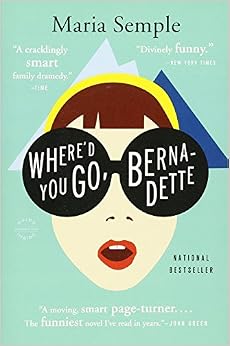
"This divinely funny, many-faceted novel...leaves convention behind. Instead, it plays to Ms. Semple's strengths as someone who can practice ventriloquism in many voices, skip over the mundane and utterly refute the notion that mixed-media fiction is bloggy, slack or lazy.... The tightly constructed WHERE'D YOU GO, BERNADETTE is written in many formats-e-mails, letters, F.B.I. documents, correspondence with a psychiatrist and even an emergency-room bill for a run-in between Bernadette and Audrey. Yet these pieces are strung together so wittily that Ms. Semple's storytelling is always front and center, in sharp focus. You could stop and pay attention to how apt each new format is, how rarely she repeats herself and how imaginatively she unveils every bit of information. But you would have to stop laughing first."―Janet Maslin, The New York TimesYou don't have to know Seattle to get Maria Semple's broadly satirical novel.... Underlying the nontraditional narrative are insights into the cost of thwarted creativity and the power of mother-daughter bonds, although a reader may be having too much fun to notice."―O, The Oprah Magazine"Delightfully droll.... Semple...cuts a wry slice of a life-one that's populated by private school helicopter parents, obsessively eco-conscious neighbors, and green-juice swilling, TED-talking husbands-and one that's sharp enough to make us feel slightly relieved about not having to live anywhere quite so bucolic."―Megan O'Grady, Vogue"The characters in Where'd You Go, Bernadette may be in real emotional pain, but Semple has the wit and perspective and imagination to make their story hilarious. I tore through this book with heedless pleasure."―Jonathan Franzen, author of Freedom"There's a lot to like in Semple's charming novel, including the vivacious humor and the lesson that when creative forces like Bernadette stop creating, they become 'a menace to society.' Even more appealing is the mutually adoring mother-daughter relationship at its warm heart."―Heller McAlpin, NPR"In her second novel...Semple pieces together a modern-day comic caper full of heart and ingenuity....a compelling composite of a woman's life-and the way she's viewed by the many people who share it. As expected from a writer who has written episodes of Arrested Development, the nuances of mundane interactions are brilliantly captured, and the overarching mystery deepens with each page, until the thoroughly satisfying dénouement."―Publisher's Weekly (Starred Review)"A comedic delight..."―Family Circle"Agoraphobia and Antarctica are among the elements in Maria Semple's terrific novel."―Parade"Semple's affecting characters, not-necessarily-nice humor and surprising plot twists make this novel an enchanting ride."―Carolyn Kellogg, Los Angeles Times"Warm, dark, sad, funny-and a little bit screwball.... This is an inventive and very funny novel that gets bonus points for transcending form."―Susan Coll, The Washington Post

Read more

About the Author

Maria Semple's first novel, This One is Mine, was set in Los Angeles, where she also wrote for television shows including Arrested Development, Mad About You, and Ellen. She escaped from Los Angeles and lives with her family in Seattle, where her second novel takes place.

Read more

Product details

Paperback: 352 pages

Publisher: Back Bay Books; Reprint edition (April 2, 2013)

Language: English

ISBN-10: 0316204269

ISBN-13: 978-0316204262

Product Dimensions:

5.6 x 1.2 x 8.2 inches

Shipping Weight: 11.2 ounces (View shipping rates and policies)

Average Customer Review:

4.3 out of 5 stars

5,639 customer reviews

Amazon Best Sellers Rank:

#783 in Books (See Top 100 in Books)

I read this as part of a book club that I am in. The writing was nice and the story was captivating. Would definitely recommend!

Fifteen year old Bee lives in Seattle with her parents in a 12,000 square ft building that once was a Catholic school for wayward girls. To say their lifestyle is unconventional would be an understatement. Their "home" has blackberry vines growing through the floorboards, a roof that leaks like a sieve, and an odor that would assault anyone's nose who might enter; yet the three of them don't seem to notice. It's not because of lack of intelligence or money. They all have Einstein level IQs. Elgin has a very high level job at Microsoft, Bernadette is an award winning architect, and Bee has been accepted to a prestigious boarding school.They are planning on taking a trip to Antarctica over Christmas break, a reward for Bee's perfect report card. But things start going awry. And then Bernadette disappears...This is a strange story told in an unique way. It's told by Bee with the help of emails, letters from school personnel, police reports, medical reports, invoices, etc. This book is satirical; certainly not a book anchored in "everyday life" realism. In this regard, it reminds me a bit of Rachael Joyce's "The Unlikely Pilgrimage of Harold Frye"."Where'd You Go, Bernadette" isn't for everyone. Of course you can say that about every book ever published, but that goes double here. I would've given up on it if not for a reading buddy who pushed me to stick it out. The characters are not likable in the beginning (or understandable), especially Bernadette. But once I got through the first quarter, I was invested in the story. And when I reached the last page, I realized wisps of Bee, Bernadette, and Elgin have been written in my memory bank with a permanent marker. They'll fade, but never completely leave.Can't possibly give this less than 4 stars.

Thank goodness I picked this book back up after not liking the Kindle sample a couple of years ago. It was so odd and quirky—laid out as a series of speakers or written communications alternating to roll out the story. So many others loved the book that I gave it another try. I'm so glad I didn't miss this highly entertaining, funny, poignant, and remarkably original work.There are so many layers here, and my review will not do it justice. It is a screamingly funny and intelligent satire of the wealthy, bright, but eccentric "Microsoft executive types" in Seattle. A review on Amazon got it just right: "A whip-smart, hysterical dramady about a family in crisis after the disappearance of its misanthropic matriarch." That matriarch was Bernadette.Bernadette—at one time a revolutionary architect with a cult-like following—dropped out of that world to accompany her equally brilliant and odd husband to Seattle for his ground-breaking work in artificial intelligence with Microsoft. Their delightful daughter Bee is achieving great things at school and is relatively oblivious to her family's eccentricities or her mother's increasing agitation and agoraphobia in dealing with the "gnats"—parents at Bee's school whose antics and priorities are hilariously sublime satire.Bernadette's disappearance sends Bee and her father on a poignant, intense, and globe-trotting search, during which they uncover much about themselves and about the power of love and the importance of being true to one's self.

I really enjoyed this book - even though it wasn't remotely what I was expecting. Told through a series of narrators, with emails, letters, and texts, this is a tightly-woven contemporary epistolary novel. The primary narrator is Bee, telling the story from her perspective as a young teen daughter. Bernadette, her mother, is a former MacArthur genius award winning architect, who is missing.The book is by turns hilarious and touching. It skewers helicopter parents, high tech, and Seattle. It also focuses on mother-daughter relationships, family dynamics, and creativity. The main characters, including Elgin the father and husband, are unforgettable. This is a book that makes you feel good!

In a nutshell, this is a book that begs the reader to not take it seriously, and just simply enjoy the amusement park ride that it is.This was recommended to me because it was "quirky and fun". I learned the author had written for a few quirky comedy television shows, which helped me in setting my expectations before jumping in. And just as anticipated, it reads like a screenplay for a fun quirky comedy. Going in with that expectation, I found the book to be a delight to read ~ the author takes what would be heavy issues in reality, and lets us see them in another light hearted way.Also, having grown up in Seattle, just a few years behind Bill Gates, and having classmates that went to work for Microsoft, there was a nostalgic / sentimental feel for me, as I read through the escapades of Bernadette and the Galer Street Gnats ... definitely quirky and fun.

For a time I lived around Cupertino, and I recognized many of the characters. I had the impression that the book would have continued in the vein (would be. 5 star review).However the quarrelsome/crazy women finds an iceberg and is rendered sane and functioning. The 15 year old daughter matures in under an hour and all is right with the world. The husband is sort of left out of the game plan.A quick read and flows well.

Where'd You Go, Bernadette: A Novel, by Maria Semple PDF
Where'd You Go, Bernadette: A Novel, by Maria Semple EPub
Where'd You Go, Bernadette: A Novel, by Maria Semple Doc
Where'd You Go, Bernadette: A Novel, by Maria Semple iBooks
Where'd You Go, Bernadette: A Novel, by Maria Semple rtf
Where'd You Go, Bernadette: A Novel, by Maria Semple Mobipocket
Where'd You Go, Bernadette: A Novel, by Maria Semple Kindle

Where'd You Go, Bernadette: A Novel, by Maria Semple PDF

Where'd You Go, Bernadette: A Novel, by Maria Semple PDF

Where'd You Go, Bernadette: A Novel, by Maria Semple PDF
Read full post »

Jumat, 25 September 2015

Ebook Download Cibola Burn (The Expanse), by James S. A. Corey

0 komentar

Ebook Download Cibola Burn (The Expanse), by James S. A. Corey

Among inspiring reasons that you can preferred to get this book is since this is really appropriate to the condition that you encounter currently. The condition is not only for you that are not scared to get brand-new thing, for you that always feel that you require new sources to make better life. And this book is really appropriate to review even in just brief free time. Yeah, with the soft data of Cibola Burn (The Expanse), By James S. A. Corey, you can take very easy to continually check out and also read this publication again.

Cibola Burn (The Expanse), by James S. A. Corey

Cibola Burn (The Expanse), by James S. A. Corey


Cibola Burn (The Expanse), by James S. A. Corey


Ebook Download Cibola Burn (The Expanse), by James S. A. Corey

New updated! The most recent book from an extremely well-known author lastly comes out. Schedule, as an incredible referral becomes what you should obtain. Exactly what's for is this publication? Are you still thinking for what the book is? Well, this is just what you probably will get. You need to have made appropriate choices for your far better life. Schedule, as a source that may include the truths, opinion, literary works, religion, and several others are the great friends to accompany.

Really feeling tired after doing some activities in trips will certainly purchase you to have leisure for some minutes. It will certainly likewise help you to satisfy the fee time. When you could enjoy your time for relaxation and ignore the view around you, it is the very best time to have also reviewing. Yeah, checking out publication ends up being a really ideal suggestion to do today. But, do are you really feel unusual not to bring specific book?

The Cibola Burn (The Expanse), By James S. A. Corey has the tendency to be terrific reading book that is understandable. This is why this book Cibola Burn (The Expanse), By James S. A. Corey ends up being a favored book to review. Why do not you want turned into one of them? You can enjoy reading Cibola Burn (The Expanse), By James S. A. Corey while doing various other tasks. The presence of the soft file of this book Cibola Burn (The Expanse), By James S. A. Corey is type of getting encounter conveniently. It consists of exactly how you must conserve guide Cibola Burn (The Expanse), By James S. A. Corey, not in shelves naturally. You could wait in your computer tool and device.

Thinking about the book Cibola Burn (The Expanse), By James S. A. Corey to review is additionally required. You can select guide based upon the favourite motifs that you like. It will involve you to like checking out various other publications Cibola Burn (The Expanse), By James S. A. Corey It can be additionally about the need that binds you to review the book. As this Cibola Burn (The Expanse), By James S. A. Corey, you could discover it as your reading book, even your favourite reading book. So, locate your favourite publication here and also get the link to download the book soft data.

Cibola Burn (The Expanse), by James S. A. Corey

Review

"It's been too long since we've had a really kickass space opera. LEVIATHAN WAKES is interplanetary adventure the way it ought to be written, the kind of SF that made me fall in love with the genre way back when, seasoned with a dollop of horror and a dash of noir. Jimmy Corey writes with the energy of a brash newcomer and the polish of a seasoned pro. So where's the second book?"―George R.R. Martin on Leviathan Wakes"The science fictional equivalent of A Song of Ice and Fire... only with fewer beheadings and way more spaceships."―NPR Books on Cibola Burn"Combining an exploration of real human frailties with big SF ideas and exciting thriller action, Corey cements the series as must-read space opera."―Library Journal on Cibola Burn (Starred Review)"The Expanse is the best space opera series running at full tilt right now, and Cibola Burn continues that streak of excellence."―io9 on Cibola Burn"A politically complex and pulse-pounding page-turner.... Corey perfectly balances character development with action... series fans will find this installment the best yet."―Publishers Weekly on Abaddon's Gate"An excellent space operatic debut in the grand tradition of Peter F. Hamilton."―Charles Stross on Leviathan Wakes"High adventure equaling the best space opera has to offer, cutting-edge technology, and a group of unforgettable characters bring the third installment of Corey's epic space drama (after Caliban's War and Leviathan Wakes) to an action-filled close while leaving room for more stories to unfold. Perhaps one of the best tales the genre has yet to produce, this superb collaboration between fantasy author Daniel Abraham and Ty Franck should reawaken an interest in old-fashioned storytelling and cinematic pacing. Highly recommended."―Library Journal on Abaddon's Gate"Literary space opera at its absolute best."―io9.com on Abaddon's Gate"[T]he authors are superb with the exciting bits: Shipboard coups and battles are a thrill to follow."―Washington Post on Abaddon's Gate"Riveting interplanetary thriller."―Publishers Weekly on Leviathan Wakes

Read more

About the Author

James S.A. Corey is the pen name of fantasy author Daniel Abraham and Ty Franck. They both live in Albuquerque, New Mexico. Find out more about this series at www.the-expanse.com.

Read more

Product details

Series: The Expanse (Book 4)

Paperback: 624 pages

Publisher: Orbit; Reprint edition (May 5, 2015)

Language: English

ISBN-10: 0316334685

ISBN-13: 978-0316334686

Product Dimensions:

6 x 2 x 9.2 inches

Shipping Weight: 1.4 pounds (View shipping rates and policies)

Average Customer Review:

4.4 out of 5 stars

914 customer reviews

Amazon Best Sellers Rank:

#4,119 in Books (See Top 100 in Books)

This is the fourth book in the seven book Expanse series (and did you know that the series might be a long as nine books?). Each book goes "Where no man has gone before..." farther and farther out into the universe and the ride is not without a few bumps.This book pushes settlers (originally from Ganymede) out through the Ring into a brand new universe. They're willing to settle on an entirely unknown planet. Things must've been really really, really bad where they came from (which is true if you've read the earlier books).In each of the books, you have the UN/Mars/OPA, a corporation (Protogen in the early books, Mao-Kwikowski Mercantile next, and Royal Charter Energy ("RCE") in the current book), the inhabitants of a moon (or settlers) and the crew of the Rocinante.RCE has the "charter", a governor, and a shipful of scientists and supplies bound for the planet the settlers call "Ilus" and RCE calls "Bering Survey Four" or "New Terra" or "24771912-F23" and it was "sitting smack dab in the middle of the Goldilocks Zone" (every planetary system has to have one of these).RCE must've never watched any Sci-Fi on TV because the organization of the captain, crew, and passengers has an entirely sovereign security group led by moderately cloaked psychopath. What could go wrong?The scientists are smart, funny, and plausible (not that I'm a scientist).Amos in the book seems bigger and balder than the actor playing him in the TV series (but Wes Chatham is permanently Amos in my head now). Amos suggested taking some supplies with them on a reconnoiter and Holden said no. "Later," Amos said, "when you're wishing we had this stuff, I am going to be merciless in my mockery. And then we'll die."Bobbie Draper is mentioned in the Prologue and then in the Epilogue. This is just a tease for the next book. Okay, so I'm looking forward to the next book."One hundred and thirteen times a second..." What's the significance of this frequency? Just another tease like mentioning Bobbie Draper at the beginning and end of the book?It was nice to see a return of Havelock, the Earther cop who worked with Miller back for Star Helix Security on Ceres and he has a moderately heroic role.The Martians have a spaceship named after astronaut Sally Ride.This book (the Kindle version) occasionally missing opening double quotes through out. Not consistently, just enough to pop the needle out of the vinyl groove about once a chapter. Too often.

UPDATE 3/30/2017 --- Yesterday I got an update email from Amazon saying that the audio narration has been updated:"""Dear Audible Listener, We are contacting you because you have reviewed the title “Cibola Burn” by James S. A. Coery (sic). The original recording has now been replaced with a new performance by Jefferson Mays. If you own this audiobook, simply re-download it from your library to access the new recording."""I downloaded the new narration and rejoiced in the sweet tones and characterizations we have all come to enjoy from Jefferson Mays. I almost cried. Although I am 2/3 of the way through the book, I am happy to listen to the rest via audio now because of this.OLD REVIEW CONCERNING PREVIOUS NARRATION:This review pertains to (mostly) the audio narration which is the worst audio narration I've listened to for any book in my life. I'm about 30% through this book at this point. The first three books have great audio narration and I was really looking forward to listening to this one. Where and why Amazon/Audible decided to hire this brainless and belligerent narrator is beyond me. Firstly, the narrator obviously hadn't listened to the previous narrator's reads of the previous books to provide any sense of continuity. Secondly, this narrator tries to 'act' the characters and does a really poor job. Unfortunately, he reads this book like it is a dime store Western/Romance novel. All the men have western cowboyish accents and all the women are read as either breathy or breathless voices. It is beyond distracting. And, even worse, this new dumb narrator's acting interpretation of Christian Avasarala is a out of breath woman on the verge of hysterics rather than the appropriate biting cynical political genius with an Indian accent. Those characters he deems not of the cowboy or helpless woman type of voice he gives either a super poor australian accent or some mixture of transylvanian/slavic (seriously sounds like a bad Dracula voice for someone with a middle eastern name). Even more unfortunate is that he has decided to provide an American Indian accent to the ghostly character of Miller. WTH!!!So, if you enjoy cheap western novels and want a book of the expanse series read to you in this way, you will have no problem with this book. If you've listened to the narration from the previous books and expect the same 'feel' of narration, skip it for this one. You'll go stark raving mad. There is hope however, for the subsequent novel narration as it reverts back to the first narrator. From wiki: This narrator's name is Erik Davies (you should be fired) and is only for Cibola Burn and the novellas Gods of Risk and The Churn. All the others are the narrator Jefferson Mays.Dear Amazon/Audible: If you switch narrators in a series, your quality control (I'm sure you have none) needs to require that the new narrator provide narration continuity. I wish I could get my money back for the audio purchase of this book. Please hire Jefferson Mays to record narration for Cibola Burn, Gods of Risk, and The Churn to replace the TERRIBLE narration of Erik Davies. Erik Davies should only be hired to record narration for awful cheap dime store Western novels. If the authors are reading this and have any pull, ask Amazon/Audible to fix this. You almost lost me as a reader.As far as the novel goes, it is a slow starter and more boring and world building type of novel than the first three. So go into it with that in mind. Maybe by the end something cool will happen but I'm not there yet.I got pulled into reading/listening to the novels by watching the TV series. Has been totally worth my time until I encountered this exceptionally poor narration.

Cibola Burn (The Expanse), by James S. A. Corey PDF
Cibola Burn (The Expanse), by James S. A. Corey EPub
Cibola Burn (The Expanse), by James S. A. Corey Doc
Cibola Burn (The Expanse), by James S. A. Corey iBooks
Cibola Burn (The Expanse), by James S. A. Corey rtf
Cibola Burn (The Expanse), by James S. A. Corey Mobipocket
Cibola Burn (The Expanse), by James S. A. Corey Kindle

Cibola Burn (The Expanse), by James S. A. Corey PDF

Cibola Burn (The Expanse), by James S. A. Corey PDF

Cibola Burn (The Expanse), by James S. A. Corey PDF
Read full post »

Selasa, 22 September 2015

Free PDF Arabian Oasis City: The Transformation of 'Unayzah (Modern Middle East (Paperback)), by Soraya Altorki

0 komentar

Free PDF Arabian Oasis City: The Transformation of 'Unayzah (Modern Middle East (Paperback)), by Soraya Altorki

In spending the downtime, many people have various methods. Yet, to make the exact same one, checking out the Arabian Oasis City: The Transformation Of 'Unayzah (Modern Middle East (Paperback)), By Soraya Altorki can be done perfectly. Also it remains in different time, you all can acquire the functions as well as benefits of the book to review. It is kind of publication with the particular topic to get over the daily issues. When you need type of home entertainment, this publication is also appropriate enough.

Arabian Oasis City: The Transformation of 'Unayzah (Modern Middle East (Paperback)), by Soraya Altorki

Arabian Oasis City: The Transformation of 'Unayzah (Modern Middle East (Paperback)), by Soraya Altorki


Arabian Oasis City: The Transformation of 'Unayzah (Modern Middle East (Paperback)), by Soraya Altorki


Free PDF Arabian Oasis City: The Transformation of 'Unayzah (Modern Middle East (Paperback)), by Soraya Altorki

Do you feel much better after finishing a book to read? Exactly what's your sensation when getting a new book again? Are you challenged to review and also finish t? Great reader! This is the time to conquer your goo behavior of analysis. We show a better publication again to take pleasure in. Seeing this site will be also filled with willingness to read? It will not make you really feel bored because we have numerous kinds and sort of the books.

Reading is the very best thing to do to meet the time. Yeah, reviewing will constantly bring benefits. Additionally, when you could comprehend what guide to read, it's actually well prepared. When you could check out guide ended up, you could get finished information that the author utters. In this situation, this publication constantly gives advantages. Arabian Oasis City: The Transformation Of 'Unayzah (Modern Middle East (Paperback)), By Soraya Altorki certainly will be so vital to accompany you in your spare time. Even it is only few web pages; you can review it by the times without forgetting what you have checked out.

Just what do you think of this publication? Are you still confused with this publication? When you are truly interested to check out based upon the title of this publication, you could see how guide will give you numerous things. It is not just about the exactly how this publication worry around, it has to do with just what you can take from the book when you have actually read. Also that's only for few web pages; it will help you to give extra inspirations. Yeah, Arabian Oasis City: The Transformation Of 'Unayzah (Modern Middle East (Paperback)), By Soraya Altorki is extremely amazing for you.

The option of you to read this publication is not based on the force to read it. it will begin to make you really feel that this book is very appropriate to read in this time. If often you will also create your suggestions into a book, learning kind this book is a great way. Arabian Oasis City: The Transformation Of 'Unayzah (Modern Middle East (Paperback)), By Soraya Altorki is not just the reading publication. It is a publication that has remarkable experience of the globe. Guide motivates to get better future. This is the reason why you should read this publication, even the soft documents book, you can get it. This is just what you require currently to test your idea of behavior.

Arabian Oasis City: The Transformation of 'Unayzah (Modern Middle East (Paperback)), by Soraya Altorki

Product details

Series: Modern Middle East (Paperback) (Book 15)

Paperback: 284 pages

Publisher: University of Texas Press; First Edition edition (July 1, 1989)

Language: English

ISBN-10: 9780292785182

ISBN-13: 978-0292785182

ASIN: 0292785186

Product Dimensions:

6 x 0.6 x 9 inches

Shipping Weight: 15.2 ounces (View shipping rates and policies)

Average Customer Review:

4.5 out of 5 stars

3 customer reviews

Amazon Best Sellers Rank:

#4,085,441 in Books (See Top 100 in Books)

...was an accolade given to Unayzah in 1924 by a Lebanese writer and advisor to Ibn Saud, Amin Rihani. I heard it in a more expansive sense, no doubt due to inflation, many years later, as the Paris of Arabia. And no less a (Western) authority on Arabia from his travels there in the 19th Century, the curmudgeonly Charles Doughty, said that he spent the "one good day" of his travels in Arabia in Unayzah.This is a very remarkable book, along several different dimensions. First of all, that it was written at all. It is the result of a partnership between a Saudi woman, and an American man, both of whom are sociologists. They had studied and taught at the same universities. Soraya Altorki's family was originally from Unayzah, which was key for obtaining authorization to conduct the study. Still, in a society in particular in which there is much skepticism towards the motives of the inquiring stranger, that permission itself is a remarkable achievement.I had to gulp hard on the first page as the authors began to differentiate between "transformation" and "development" and knew that "modes of productions" and associated jargon could not be far behind. After all, this IS sociology, and the tone of the book is excessively flat and scholarly. But if the reader is willing to adjust to this mode, s/he should be richly rewarded. Because the authors tell a remarkable story, yes, a "transformation" in one city in central Arabia, debunking many common myths like the Arabs always eschewed manual labor. Their reasons for this study is explained in the introduction, and resonated well with me: "...for letting the people tell much of the story in their own words, derives from our reaction to much of the literature that has been published on Saudi Arabia in recent years. Quite a lot has been written about society in Saudi Arabia by foreigners who happened to live there but who were not social scientists. Much of this has been anecdotal at best and often inflammatory and misleading. More serious are the writing of social scientists who have either never been to the country or have only briefly visited some of the main cities."In terms of "telling their own story," I found the stories told by Abu Talib, an 88 year old, on pages 76-80, who traveled throughout much of the Middle East during and after WW I, and Abu Ziyad, on page 175, who had lived in Europe for seven years, and returned to Unayzah for his health particularly well done. Ms. Altorki enabled the stories of the women to also be well told, from their days working in agriculture to their current work as school teachers and their experiences in socializing, via "coffee klatches" and more.The central aspect of the book, a description of the "transformation" of this city from an agricultural base, supported by long-distant traders, where education is admired, to the current (1989) state where the old lines of work and trading disappeared, and government employment was providing, along with new housing, compliments of the "tufrah," the "oil boom," was accomplished admirably. I agree with their assessment on page 120: "changes of such vast proportions in such a short time have probably never occurred in any country during times of peace."There are a few points I wish I could query the authors on: there was no mention of anyone refusing to participate in their study; there was also no skepticism that what they were told was not true, for example, on page 128 they seemed to accept the assertion that the maids "do not play an important part in childrearing." As is now known here in the American Southwest, sometimes the Indians, tired of being "specimen studies," would embroider tales for sociologist's consumption. No doubt the authors would claim that it was "beyond the scope of this study," but a contrast of the outwardly looking and "liberal" Unayzah with insular, and extremely conservative Buraydah, only 20 km away, on the north side of Wadi Al Rimmah, was never done, nor even alluded to. Truly a fascinating subject for a follow-up study. And perhaps understandably, a description of the part that religion played in the lives of the Unayzah's citizens was minimized; thereby avoiding controversy, yet the reader is poorer in his/her understanding. And I felt the authors was overly pessimistic concerning the future, as though they actually had internalized the constant predictions of many of the West that the day of collapse is always 2-3 years away.On a personal note, during the days of the electrification of Qassim province, almost 30 years ago, my wife and I were once shown around Unayzah, its old homes, its date production, et al., by one of the community leaders who beamed pride in Unayzah's history and accomplishments. That evening we ate chicken, and drank "Bebsi" in a "sidewalk café" watching the traffic pass, and pondered the differences between Unayzah's openness and insular Buryadah. And we thought it was better to be in Unayzah than the real Paris. Cole and Altorki have done much to explain what we did not understand at the time.Sadly, this illuminating, solid factual account of those in the very heartland of Islam is currently selling with a rank in the millions at Amazon, whereby the books that promote a fantasy view of this country and religion are always much better sellers. You don't have to be a sociologist to ponder what does this say about ourselves?

The media images of Saudi Arabia concentrate on camels, dunes, huge crowds of pilgrims at Mecca and Madinah, and large installations dedicated to the oil industry. Outsiders see almost nothing of Saudi life (though we hear a lot about women not being able to drive, chopping of heads etc.) Without much tourism, without films that tell about life there, without any Saudi neighbors (I've met one Saudi in my entire life and that was 45 years ago), a book like ARABIAN OASIS CITY can provide a major change in the way you view the country. At the beginning of the twentieth century, the area that would become Saudi Arabia still moved in traditional ways. It had never been much part of the larger empires that rose and fell in the Middle East. The appearance of the kingdom that became known as "Saudi Arabia" (in the 1920s) meant a gradual changing of the society and economy. Up to the 1930s and the beginning of oil production, change proceeded slowly. The two anthropologist-authors here interviewed many people (in the 1980s) who could remember those times very well. Through their memories, plus the straightforward writing of the authors, who do not embellish their text with jargon or footnotes, a picture emerges of a very stable society devoted to agriculture, animal husbandry, and trade. Farmers raised wheat and 30 kinds of dates on land that they owned or leased (some leases ran even to 500 years, surely one for the Guiness Book of Records !) Many craftsmen practised their trades and men drove herds of animals up to Syria or Palestine for sale. Both women and men sold produce and various craft items in the bazaar. Women also worked on farms as laborers. A network of trading/merchant families lived in many parts of the Arab world and even in India, expediting business for the people back home in `Unayzah, the central Saudi city that is the focus of this study. We look at family patterns, levels of indebtedness, and the market as a center of social and political interaction. "For a very long time and until not too long ago, `Unayzah had a complex economic structure and its population had a high degree of occupational specialization. It was a center tied into various networks that operated locally, regionally, and at an international level." (p.81) Having established what once existed, the authors spend the rest of the book telling what happened as Saudi Arabia transformed itself thanks to the flow of oil money that became a flood after the oil price rise of the 1970s. We may say that five major changes occured. They investigate each thoroughly---secular education, new technology and new infrastructure, salaried employment especially in the government, the arrival of a vast, cheap workforce of expatriate laborers, and a cash economy. These affected family life, friendship patterns, male-female relations, daily behavior, expectations of the future, and attitudes towards nearly everything, especially work. The sub-title given to the book, "the transformation of `Unayzah" is thus very accurate. The research was done by a man and a woman working in tandem but separately in accordance with Saudi mores. The result is satisfying if you are looking for a descriptive work on how Saudi society has changed over the years. There is little or no theoretical content, little relating to the vast body of anthropological research that has gone on over the years. Some books err in having too much theory and not enough content. Not this one. The authors make a vague nod in the direction of theory with a discussion of a "rentier" model gleaned from several works, but only in the last ten pages. Frankly, it seems to be tacked on to what othewise is a solid descriptive work. They want to make the point that the present avoidance of manual labor by large parts of the Saudi work force is a function of the economic conditions prevailing since the `boom' of the 1970s and not something that is traditional in any way. I would say in conclusion that this book must be read by anyone who is concerned with Saudi Arabia or the changing societies of the Middle East. And, I think, that should include nearly everyone !

This book reports on a study the 2 authors did in Unayzah, a mid-size city in central Saudi Arabia. The study was particularly well planned in that the authors, an American man and a Saudi woman, were able to combine the views of both outsiders and insiders, men and women into a single seamless whole. Through interviews with local people, the authors present a history of the development of Unayzah from an agricultural and market center before oil wealth to the city it is today. They describe the early transport industry and the work women did in agriculture and the market as well as the longstanding importance of education in this city. They also describe the tremendous changes that have taken place since oil wealth, particularly with the importation of foreign labor and the construction of modern housing in new areas. Early in the book, the authors suggest that they will make a distinction between "transformation" of economy/society and "development". As the book unfolds, they do not focus on arguing for this distinction explicitly, although many facts gradually build to support their case. Descriptions of changes in family life in Unayzah present some interesting comparisons of the pros and cons of abandoning or adapting tradition in favor of "modern" customs. This book is a must for anyone who would like to learn more about modern Saudi society.

Arabian Oasis City: The Transformation of 'Unayzah (Modern Middle East (Paperback)), by Soraya Altorki PDF
Arabian Oasis City: The Transformation of 'Unayzah (Modern Middle East (Paperback)), by Soraya Altorki EPub
Arabian Oasis City: The Transformation of 'Unayzah (Modern Middle East (Paperback)), by Soraya Altorki Doc
Arabian Oasis City: The Transformation of 'Unayzah (Modern Middle East (Paperback)), by Soraya Altorki iBooks
Arabian Oasis City: The Transformation of 'Unayzah (Modern Middle East (Paperback)), by Soraya Altorki rtf
Arabian Oasis City: The Transformation of 'Unayzah (Modern Middle East (Paperback)), by Soraya Altorki Mobipocket
Arabian Oasis City: The Transformation of 'Unayzah (Modern Middle East (Paperback)), by Soraya Altorki Kindle

Arabian Oasis City: The Transformation of 'Unayzah (Modern Middle East (Paperback)), by Soraya Altorki PDF

Arabian Oasis City: The Transformation of 'Unayzah (Modern Middle East (Paperback)), by Soraya Altorki PDF

Arabian Oasis City: The Transformation of 'Unayzah (Modern Middle East (Paperback)), by Soraya Altorki PDF
Read full post »

Senin, 07 September 2015

Ebook Download , by Fumio Sasaki

0 komentar

Ebook Download , by Fumio Sasaki

Do you feel much better after finishing a book to review? Just what's your sensation when obtaining a brand-new publication again? Are you tested to review and complete t? Good reader! This is the moment to overcome your goo practice of analysis. We reveal a better publication again to delight in. Seeing this site will be also full of willingness to check out? It will certainly not make you feel bored because we have numerous kinds and kinds of guides.

, by Fumio Sasaki

, by Fumio Sasaki


, by Fumio Sasaki


Ebook Download , by Fumio Sasaki

When somebody assumes that reading is a crucial activity to do for the human life, a few other could think about how reading will be so monotonous. It's usual. When many people prefer to pick going someplace as well as chatting with their close friends, some individuals like to g to guide stores and hunt for the brand-new book launched. Just how if you don't have adequate time to go guide shop?

In wondering the things that you must do, reading can be a brand-new choice of you in making new things. It's constantly stated that reading will always assist you to overcome something to far better. Yeah, , By Fumio Sasaki is one that we always provide. Also we share time and again regarding the books, just what's your perception? If you are just one of individuals love reviewing as a way, you can discover , By Fumio Sasaki as your analysis product.

When increasing and also advertising this publication we are likewise so certain that you could gain the lesson as well as expertise conveniently. Why? With your basic knowledge as well as ideas, your option to blend with the lessons offered by this publication is really amazing. You could locate the right selection of exactly how the here and now publication in this lesson is gotten. And now, when you are really locate of this kind of book topic, you can acquire the documents of guide in this rest.

By downloading this soft file book , By Fumio Sasaki in the online link download, you remain in the initial step right to do. This site truly provides you ease of the best ways to obtain the best e-book, from ideal seller to the brand-new released book. You could find more e-books in this website by visiting every link that we give. Among the collections, , By Fumio Sasaki is among the most effective collections to offer. So, the very first you get it, the initial you will certainly obtain all positive concerning this publication , By Fumio Sasaki

, by Fumio Sasaki

Product details

File Size: 54171 KB

Print Length: 260 pages

Publisher: W. W. Norton & Company; 1 edition (April 11, 2017)

Publication Date: April 11, 2017

Sold by: Amazon Digital Services LLC

Language: English

ASIN: B01HDSU7KE

Text-to-Speech:

Enabled

P.when("jQuery", "a-popover", "ready").execute(function ($, popover) {

var $ttsPopover = $('#ttsPop');

popover.create($ttsPopover, {

"closeButton": "false",

"position": "triggerBottom",

"width": "256",

"popoverLabel": "Text-to-Speech Popover",

"closeButtonLabel": "Text-to-Speech Close Popover",

"content": '

' + "Text-to-Speech is available for the Kindle Fire HDX, Kindle Fire HD, Kindle Fire, Kindle Touch, Kindle Keyboard, Kindle (2nd generation), Kindle DX, Amazon Echo, Amazon Tap, and Echo Dot." + '
'

});

});

X-Ray:

Enabled

P.when("jQuery", "a-popover", "ready").execute(function ($, popover) {

var $xrayPopover = $('#xrayPop_22A81692425511E9924D9629FEFF785F');

popover.create($xrayPopover, {

"closeButton": "false",

"position": "triggerBottom",

"width": "256",

"popoverLabel": "X-Ray Popover ",

"closeButtonLabel": "X-Ray Close Popover",

"content": '

' + "X-Ray is available on touch screen Kindle E-readers, Kindle Fire 2nd Generation and later, Kindle for iOS, and the latest version of Kindle for Android." + '
',

});

});

Word Wise: Enabled

Lending: Not Enabled

Screen Reader:

Supported

P.when("jQuery", "a-popover", "ready").execute(function ($, popover) {

var $screenReaderPopover = $('#screenReaderPopover');

popover.create($screenReaderPopover, {

"position": "triggerBottom",

"width": "500",

"content": '

' + "The text of this e-book can be read by popular screen readers. Descriptive text for images (known as “ALT text”) can be read using the Kindle for PC app and on Fire OS devices if the publisher has included it. If this e-book contains other types of non-text content (for example, some charts and math equations), that content will not currently be read by screen readers. Learn more" + '
',

"popoverLabel": "The text of this e-book can be read by popular screen readers. Descriptive text for images (known as “ALT text”) can be read using the Kindle for PC app if the publisher has included it. If this e-book contains other types of non-text content (for example, some charts and math equations), that content will not currently be read by screen readers.",

"closeButtonLabel": "Screen Reader Close Popover"

});

});

Enhanced Typesetting:

Enabled

P.when("jQuery", "a-popover", "ready").execute(function ($, popover) {

var $typesettingPopover = $('#typesettingPopover');

popover.create($typesettingPopover, {

"position": "triggerBottom",

"width": "256",

"content": '

' + "Enhanced typesetting improvements offer faster reading with less eye strain and beautiful page layouts, even at larger font sizes. Learn More" + '
',

"popoverLabel": "Enhanced Typesetting Popover",

"closeButtonLabel": "Enhanced Typesetting Close Popover"

});

});

Amazon Best Sellers Rank:

#13,231 Paid in Kindle Store (See Top 100 Paid in Kindle Store)

Having consulted countless self-help books written by gurus who appear to have it all figured out, “Goodbye, Things” was a breath of fresh air to me. Fumio Sasaki’s tone is quiet, contemplative, open-minded, and above all, humble. I easily identified with his description of how he used to be: constantly making myself miserable by comparing myself to others; berating myself for not keeping up with household chores; spending way too much time on internet research to buy something, only to never get much use out of that item. And if a self-proclaimed “regular guy” like him could go from being a depressed shop-a-holic living in a dark, messy apartment to waking up with the sun every morning feeling happy and grateful, I couldn’t see any reason not to give this minimalism thing a try myself.When I discovered the Japanese version of this book over a year ago, my husband and I had already downsized quite a bit after reading Marie Kondo’s “Life-Changing Magic of Tidying Up.” But reading “Goodbye, Things” has had even more of a dramatic impact on our lives, mainly because it made us think fundamentally about how we use, and why we keep, certain things. Our priority went from “living in a nice apartment full of things we love” to “minimizing our footprint to maximize our time and freedom.” We used to talk about buying a condo someday; now the idea of taking out a mortgage or being tied down to a place does not sound appealing to us at all. We used to tell each other we should entertain guests more often; now we realize that was only because our friends like to host dinner parties, and we felt guilty for not reciprocating. We have accepted that the number of things we can realistically take care of are much, much smaller than we once thought.“Goodbye, Things” also helped us let go of items that sparked joy but we weren’t actually using or taking good care of. I really resonated with Sasaki’s observation of the “Silent To-Do List”: the more objects we have in our surroundings, the more they contribute to our already overwhelmed sensory load, and the more time and energy they take up. My husband and I used to have three bookshelves full of our favorite books, but now we only keep a handful that we are actually reading. We also let go of our long-owned musical instruments, after we finally came to terms with the fact that playing them just was not our passion or priority anymore. As difficult as this was, now it feels as though a huge weight has been lifted off our shoulders.Overall, I found this book to be a very helpful and inspiring introduction to minimalism, and for my husband and me, it really did change our lives.

I purchased a bunch of Kindle books on decluttering a few years back, including the Marie Kondo one. They had some good ideas, but somehow I just kept collecting stuff. A couple weeks ago, this popped up in one of the srollbars on my Amazon homepage, and I picked it up (Kindle) on a whim.So glad I did! For whatever reason, this one matched me better than the others, possibly because it looked like the author had some of the same issues I struggle with (books, in particular). One of his other offhand observations was that his old bed was heavy, and that was pretty much a direct hit too! I live with a couple cats in a one-bedroom apartment, and I refuse to get a bigger place just because the square footage has too much stuff for me to set up a writing/creative area.With this book, I figured out a way to open up a lot of space in my current apartment, and while I doubt I'll make it to a real "minimalist" living space, I can definitely see getting down to a slender "mediumist" place. (I love my backup toilet paper!) This book doesn't "shame" you either, if you don't happen to want to get down to practically no possessions, it just does a wonderful job of explaining how to let go and find your own balance so your stuff doesn't take over your life.

At first I wasn't sure about this book. "Great," I thought, "another single, male, Fight-Club-quoting, Steve-Jobs-idolizing minimalist is here to tell us how superior he is for reducing his life to a mattress and a MacBook." I wasn't far off in some ways, but before long the author's openness and lack of pretension had completely won me over.The first part of the book is practical advice, and though he includes references to minimalist friends with spouses, hobbies, and children, it's mostly oriented toward people like himself. (The advice is still pretty good). For me the best part of the book was the second half, where he talked at length about the changes minimalism had made in his inner life. I found myself nodding in along as he talked about silent to-do lists and the procrastination they cause, the joy of living in the present, and finding value in just being ordinary.Recommended to anyone who thinks of minimalism as chilly or self-centered, because this book will fill you with warmth.Not recommended to anyone who is just looking for the perfect manual. That's not what this is trying to be.

I'm very happy I purchased this book. As someone who wants to reduce belongings and simplify life it's hard to justify buying another book but this does have a ton of wonderful ideas to help you let go, simplify, etc. (tangible and nontangible things).

So many things I've read on minimalism focuses on decluttering your possessions. One level up from this are the most typical reasons to minimise and the typical benefits. Goodbye things goes one level higher by discussing how your whole lifestyle, thought process and perspective can change. I feel like this book puts into words the fundamental obstacles and urges people who are interested in minimalism have but are unable to articulate fully. Reading this book gave me such a sense of relief, like all my unarticulated yearnings to simplify and find happiness had somehow tumbled out and were being reflected in every word written on the pages of this book. For every person looking to become a minimalist but can't quite find the motivation, I highly recommend this book.

I've read dozens of minimalism books- definitely some better than others, but this one by Fumio Sasaki is probably one of my favorites, if not the absolute favorite. His words inspire without being condescending or laying on the guilt. He makes you believe that minimizing your possessions is not only doable for the average maximalist, but also that doing so will revolutionize your life. I have already been in the process of minimizing, but this will serve as inspiration now and again in the future. Enjoyed it so much that I intend to start it over again tomorrow.

, by Fumio Sasaki PDF
, by Fumio Sasaki EPub
, by Fumio Sasaki Doc
, by Fumio Sasaki iBooks
, by Fumio Sasaki rtf
, by Fumio Sasaki Mobipocket
, by Fumio Sasaki Kindle

, by Fumio Sasaki PDF

, by Fumio Sasaki PDF

, by Fumio Sasaki PDF
Read full post »

Ebook Download Harlem: The Four Hundred Year History from Dutch Village to Capital of Black America, by Jonathan Gill

0 komentar

Ebook Download Harlem: The Four Hundred Year History from Dutch Village to Capital of Black America, by Jonathan Gill

Hundreds of ready-books to review are given in this website. We, as online collection site will certainly constantly give newer or late update of publications from lots of nations on the planet. It will certainly lead you to relieve our means to seek for the alternative kinds of publications. Without travelling, without spending much cash, and also without investing much time come to be some advantages of taking books from this site. And also below, a Harlem: The Four Hundred Year History From Dutch Village To Capital Of Black America, By Jonathan Gill is one of the most up to date publication rates.

Harlem: The Four Hundred Year History from Dutch Village to Capital of Black America, by Jonathan Gill

Harlem: The Four Hundred Year History from Dutch Village to Capital of Black America, by Jonathan Gill


Harlem: The Four Hundred Year History from Dutch Village to Capital of Black America, by Jonathan Gill


Ebook Download Harlem: The Four Hundred Year History from Dutch Village to Capital of Black America, by Jonathan Gill

Have you heard that reading can boost the brain to function well? Some individuals truly believe with that said situation. Nonetheless, many individuals additionally include that it's not regarding reading. It has to do with just what you can take the message as well as impression of the book that you check out. Well, why can you assume that way? Yet, we make sure that analysis by technique as well as sensible can make the reader read it quite possibly.

The perks to consider checking out the books Harlem: The Four Hundred Year History From Dutch Village To Capital Of Black America, By Jonathan Gill are coming to enhance your life quality. The life quality will not simply concerning how much knowledge you will obtain. Also you review the enjoyable or entertaining e-books, it will aid you to have boosting life top quality. Feeling enjoyable will lead you to do something perfectly. In addition, the publication Harlem: The Four Hundred Year History From Dutch Village To Capital Of Black America, By Jonathan Gill will provide you the driving lesson to take as a good factor to do something. You may not be pointless when reading this e-book Harlem: The Four Hundred Year History From Dutch Village To Capital Of Black America, By Jonathan Gill

Currently we welcome once again, the depictive book collections from this web site. We constantly update the collections with the most up to date book visibility. Yeah, released publications are actually covered by the ways of the recommended details. The Harlem: The Four Hundred Year History From Dutch Village To Capital Of Black America, By Jonathan Gill web content that is offered actually features just what you require. In order to evoke the factors of this book to read, you should actually recognize that the history of this book comes from a great writer as well as professional publisher.

When more, reading routine will certainly consistently provide beneficial advantages for you. You could not should invest often times to read the publication Harlem: The Four Hundred Year History From Dutch Village To Capital Of Black America, By Jonathan Gill Simply alloted numerous times in our extra or downtimes while having meal or in your office to check out. This Harlem: The Four Hundred Year History From Dutch Village To Capital Of Black America, By Jonathan Gill will reveal you brand-new thing that you could do now. It will certainly assist you to improve the top quality of your life. Occasion it is merely a fun publication Harlem: The Four Hundred Year History From Dutch Village To Capital Of Black America, By Jonathan Gill, you could be healthier as well as more fun to appreciate reading.

Harlem: The Four Hundred Year History from Dutch Village to Capital of Black America, by Jonathan Gill

From Publishers Weekly

Historian Gill documents Harlem's transformation from the early days of Dutch settlements and farms to its apogee as the site of one of the 20th century's most influential musical and literary flowerings in a dense, deftly told history. The author takes us from colonial Harlem, so strategically important in the American Revolution, to the 20th-century crucible of African-American arts and intellectual development, a place so vaunted that "Negroes wanted to go to Harlem the way the dead wanted to go to heaven." He invokes a veritable who's who of the black arts and intelligentsia who either called the neighborhood home or launched their careers in its embrace. Gill's analysis of Harlem's decline in the 1970s and the concomitant unemployment and crime is thorough, although his account of the Black Panthers and his analysis of the era's various "disturbances"--particularly a 1967 riot following a fatal episode of police brutality--wants a more nuanced interpretation. From the 1994 economic revitalization to the specter of gentrification, Gill makes a persuasive case that "change is Harlem's defining characteristic," and readers of this vibrant history will appreciate every step of its singular evolution. (Feb.) (c) Copyright PWxyz, LLC. All rights reserved.

Read more

From Booklist

*Starred Review* How did Harlem evolve from a Dutch colonial outpost to the most storied of African American neighborhoods? History and literature scholar Gill offers an exquisitely detailed account of the 400-year history of Harlem. Gill tracks Henry Hudson�s accidental encounter with the island of Manahatta as he searched for China, the struggle between the Dutch and the British to claim the area, the Revolutionary War, and the later establishment of wealthy estates. He chronicles the waves of immigrants in the nineteenth century, who added to the pulse and texture of the developing urban culture. In the twentieth century, as African Americans migrated from the South and the West Indies, they began to dominate the culture, and the Harlem Renaissance put its indelible stamp on the neighborhood. Gill details major figures from George Washington and Alexander Hamilton to Langston Hughes, Marcus Garvey, and Malcolm X as well as the vibrancy of music, art, literature, religion, politics, and urban sensibility that has come to signify Harlem. Richly researched, the book details the particular blend of street-corner preaching and political proselytizing as well as the drive of black commerce and civil rights that also have come to signify African American Harlem. A vibrant, well-paced, engaging history of an iconic neighborhood. --Vanessa Bush

Read more

See all Editorial Reviews

Product details

Hardcover: 448 pages

Publisher: Grove Press; First Edition edition (February 1, 2011)

Language: English

ISBN-10: 0802119107

ISBN-13: 978-0802119100

Product Dimensions:

6.2 x 2 x 9.2 inches

Shipping Weight: 2 pounds

Average Customer Review:

4.6 out of 5 stars

38 customer reviews

Amazon Best Sellers Rank:

#294,490 in Books (See Top 100 in Books)

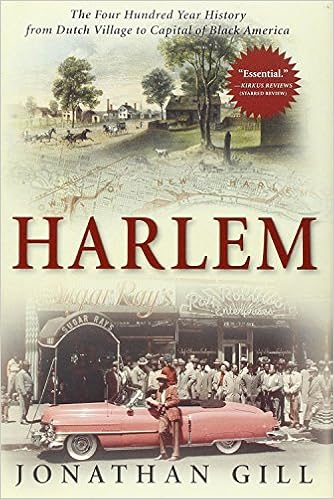
Having been born in Harlem, loved it, studied it, and penned my own experience of growing up there in the 1950s and `60s, I thought I knew, at least a little bit about everything there was to know about my beloved community. Jonathan Gill's comprehensive book, Harlem: The Four Hundred Year History From Dutch Village to Capital of Black America, disabused me of that misconception.Gill has written a "complete" history starting with Henry Hudson sailing up the Hudson River in 1609, and ending with the 2009 relocation of founding father, Alexander Hamilton's historic home which, until its move around the corner and down the hill, sat across the street from my house.Sometimes Gill's detail is sometimes excessive, but his breezy tidbits make up for it. A few examples: Madam Jumel (once married to Aaron Burr) was said to be the model for Dickens' character, Mrs. Havisham. The term "hot dog" was reportedly coined at the Polo Grounds stadium in 1901 because center field ended 483 feet away, thus "... making a home run there a near impossibility." In 1904, it took 31 minutes to travel by subway from 125th St. to 145th.Four hundred years of history is a lot to cram into one book, especially a beguiling place like Harlem with its larger-than-life reputation. A mere dot on a map, Harlem only measures about three square tucked-away miles on the upper part of an island empire and, at least in recent decades, has largely been maligned and often ignored by the ruling class.Gill does not skimp on Harlem's hellish years, but he also captures its vibe and enormous influence on music, religion, the arts, literature, fashion, sports, cuisine, politics, migration, and its involvement in both racial strife and ethnic diversity.I'm happy to have finally read this encyclopedia-like compendium. It's scholarly, but generally easy reading. Some of the transitions are not always smooth, and because his footnotes were so voluminous, he does not list them at the back of the book; instead, he directs readers to his website, which is no longer easy to find. Many times I wanted to look up a reference while reading, but wasn't near a computer, and even if I was, looking things up is a lot to ask when you're already trying to get through 450 pages.Sugar Hill: Where The Sun Rose Over Harlem

I found this to be a very informative and detailed history of Harlem, the neighborhood on Manhattan Island from 145th Street in the south to 155th street in the north with Edgecomb Avenue to the east and Amsterdam Avenue to the west. The author provides very historical details from the settlement of Manhattan by the Dutch right up to the present time. I have to confess I felt overwhelmed by the numerous details. An example would be cartoonist Thomas Nast who was responsible for the elephant being the logo for the Republican party in addition to the caricature of Santa Claus.Author Gill provides us with the history of iconic landmarks such as the Polo Grounds, home to the New York Giants through the 1957 season, the Apollo Theatre, and the Morris-Jumel mansion. Several individuals from the entertainment world such as George and Ira Gershwin, the Marx brothers, Billie Holiday, Bert Williams, "Fats" Waller, Duke Ellington, and Paul Robeson are given their deserved space in any history of Harlem. New York Giants' iconic center fielder Willie Mays, Adam Clayton Powell, Malcolm Little (better known as Malcolm X), boxer Sugar Ray Robinson, and also Harlem resident former President Bill Clinton are also deservedly included. Some details are also provided regarding the conviction and execution of Officer Charles Becker and the gangsters involved in the murder of Herman Rosenthal.Author Jonathan Gill deserves a lot of credit for the enormous amount of detail he provides on the history of Harlem. He has done a thorough job. However, speaking for myself, I found the detail excessive and I did find myself getting bogged down at times getting through it all. This is a five star book, but for me personally, I must give it four stars indicating that "I like it."

This is a very detailed history of that section of Manhattan known as Harlem. From the first settlements at the lower tip of the island, to the first few farms "uptown," the author writes about the development of one of the most recognizable places in the world. Mr. Gill covers everything from the first efforts to farm, to the great migrations that affected Harlem, to the music, dance, and entertainment center it became - and everything in between, before, and after. Sometimes the street names became a little tedious for me, because I don't live there and am not to familiar with those streets except in a general idea of where they are. Actually, I was drawn to this book by the fact that my son lives in Harlem, near the Abbyssinian Baptist Church! Now I feel I know his neighborhood very well!

This is very engaging history with interesting detail that brings the centuries to life. Not only is it a history of a fascinating place, it introduces a host of characters whose imprints have contributed to the personality of Harlem. These include Aaron Burr, John James Audubon, Thomas Nast, Cab Calloway, Malcolm X, and Geoffrey Canada. Gill emphasizes race, music and the arts, and economic factors that have played key roles in Harlem's ascent, decline and resurgence.Most interesting were the waves of immigration and how generations of politicians courted these constituents while largely leaving them unsupported while in office. Undeniably, music is associated with Harlem and a great deal of the book is dedicated to this fact. Fascinating to me is the rough years in New York from the mid 1960's through the 1970's when a declining and bankrupt city almost went under. Gill provides shocking facts including Harlem's 820 people per acre density (three times the Manhattan average), how urban renewal was equated with "Negro removal", and more than a third of heroin addicts in the U.S. lived in Harlem in the late 1970's. The author ends his history on a hopeful note recognizing that Harlem has been experiencing a real estate renaissance. Ironically (perhaps humorously) he points to the arrival of Target and Costco as positive signs.

Harlem: The Four Hundred Year History from Dutch Village to Capital of Black America, by Jonathan Gill PDF
Harlem: The Four Hundred Year History from Dutch Village to Capital of Black America, by Jonathan Gill EPub
Harlem: The Four Hundred Year History from Dutch Village to Capital of Black America, by Jonathan Gill Doc
Harlem: The Four Hundred Year History from Dutch Village to Capital of Black America, by Jonathan Gill iBooks
Harlem: The Four Hundred Year History from Dutch Village to Capital of Black America, by Jonathan Gill rtf
Harlem: The Four Hundred Year History from Dutch Village to Capital of Black America, by Jonathan Gill Mobipocket
Harlem: The Four Hundred Year History from Dutch Village to Capital of Black America, by Jonathan Gill Kindle

Harlem: The Four Hundred Year History from Dutch Village to Capital of Black America, by Jonathan Gill PDF

Harlem: The Four Hundred Year History from Dutch Village to Capital of Black America, by Jonathan Gill PDF

Harlem: The Four Hundred Year History from Dutch Village to Capital of Black America, by Jonathan Gill PDF
Read full post »

Kamis, 20 Agustus 2015

Free PDF Parenting Coordination: A Practical Guide for Family Law Professionals

0 komentar

Free PDF Parenting Coordination: A Practical Guide for Family Law Professionals

And why don't attempt this publication to review? Parenting Coordination: A Practical Guide For Family Law Professionals is one of one of the most referred reading product for any degrees. When you really wish to seek for the new inspiring publication to check out and you don't have any kind of ideas at all, this adhering to book can be taken. This is not made complex publication, no challenging words to review, and any kind of challenging style and also topics to understand. The book is extremely appreciated to be one of one of the most inspiring coming publications this just recently.

Parenting Coordination: A Practical Guide for Family Law Professionals

Parenting Coordination: A Practical Guide for Family Law Professionals


Parenting Coordination: A Practical Guide for Family Law Professionals


Free PDF Parenting Coordination: A Practical Guide for Family Law Professionals

When somebody assumes that analysis is an important task to do for the human life, a few other may consider exactly how analysis will certainly be so monotonous. It's usual. When lots of people prefer to choose going someplace as well as talking with their pals, some individuals choose to g to the book shops and also hunt for the new book released. Just how if you don't have adequate time to go guide store?

Getting guides Parenting Coordination: A Practical Guide For Family Law Professionals now is not kind of hard means. You can not simply opting for publication store or library or borrowing from your friends to review them. This is a very easy method to precisely get the publication by on-line. This on the internet e-book Parenting Coordination: A Practical Guide For Family Law Professionals can be one of the choices to accompany you when having extra time. It will not squander your time. Believe me, the e-book will certainly show you brand-new thing to read. Simply invest little time to open this on-line book Parenting Coordination: A Practical Guide For Family Law Professionals and read them any place you are now.

As known, publication is a very good source to take when you are preparing to do something, having problem to resolve, or having job for due date. It can be a good friend for you to spend the moment beneficially. Promotion about this book has been in numerous methods. As right here, we provide you're the Parenting Coordination: A Practical Guide For Family Law Professionals since it actually gives remarkable system of somebody to review it.

Well, reading this book is not kind of difficult thing. You can only set aside the time for only few in away. When waiting for the list, waiting for someone, or when gong to the bed, you can take this book to read. Never worry, you can save it into the computer device or save it in your gadget. So, it will not make you feel hard to bring the book everywhere. Because, the Parenting Coordination: A Practical Guide For Family Law Professionals that we provided in this website is the soft file forms.

Parenting Coordination: A Practical Guide for Family Law Professionals

From the Back Cover

568

Read more

Product details

Paperback: 352 pages

Publisher: Springer Publishing Company; 1 edition (February 18, 2011)

Language: English

ISBN-10: 0826106471

ISBN-13: 978-0826106476

Product Dimensions:

6 x 0.8 x 9 inches

Shipping Weight: 1 pounds (View shipping rates and policies)

Average Customer Review:

4.6 out of 5 stars

8 customer reviews

Amazon Best Sellers Rank:

#274,422 in Books (See Top 100 in Books)

Dr. Carter explains what parent coordinators & GALs have been taught and NOT been taught and what they can and cannot do. She reveals how a parent coordinator or GAL, even with knowledge and skill, might not act independently and might overly rely on a judge or therapist that might also be misguided and might not get a true picture of the family dynamics and what is best for the children. It would be interesting if Dr. Carter would comment about Dr. Amy Baker's & Dr. Craig Childress's work on "restrictive gatekeeping parenting" as well as covert abusive parenting allowed by misguided or uncaring judges as portrayed in the 2017 documentary "Erasing Family.”

Dr. Debra Carter has taken cutting edge research, years of experience in the field and written an easy to understand and practical guide for not only family law professionals but also helpful to parents experiencing a high conflict divorce and the resulting problems for children and extended family. I work in the field of family law and find Dr. Carter's book to be easily readable, a valuable tool for educating parents and helpful to me in writing parenting plans and parenting evaluations. Dr. Carter's book takes very lofty and recent research and puts it in a format anyone can easily use in their practice. I recommend it to parents as I think it can help non-professionals to parent effectively through a difficult separation or divorce. I highly recommend this book. I am using it myself in my own practice and find it very effective. If I could give more than five stars I would!

Am still reading it.It's written in a perfect and easy English,Very interesting

This is a very helpful, well thought out text.

Quite good. Has validated my understanding of the role.

I recommend Parenting Coordination for anyone who is considering using the parenting coordination process to resolve disputes over time-sharing and parental responsibility. Dr. Carter uses language that is easy to read and understand, making this book a useful tool for both parents and professionals. Dr. Carter explains the unique professional role of a parenting coordinator and provides a step-by-step approach to the parenting coordination process. Each time I pick up this book, I learn a little more and the more I learn, the more I am inspired by the opportunities parenting coordination provides to parents who are entrenched in conflict. This alternative to expensive and damaging litigation should be available to parents in every jurisdiction. The book is a good academic treatise, but I really hope it will also encourage qualified professionals to obtain training and provide these services to families in their communities.

This book is not only well written and a wonderful resource on the research in this area, but as the title claims practical for the professional as well as the family who may be experiencing this level of conflict. Dr. Carter's breadth of experience and knowledge is readily apparent throughout the book, offering clearly written direction and guidance. Further, Dr. Carter's sincere objective to assist those working in this area so they may offer child-centered services that result in outcomes that are in the best interest of the child is not only vitally important but inspirational.

Having worked as a Parenting Coordinator for several years, I thought I knew it all. This book has me thinking and re-thinking all aspects of my practice from intervention styles to liability management to marketing. The author has done a great job of translating the research into practical terms. No one should practice as a Parenting Coordinator without having read this book. I am so impressed that I'm going to re-train with Dr. Carter.Parenting Coordination: A Practical Guide for Family Law Professionals

Parenting Coordination: A Practical Guide for Family Law Professionals PDF
Parenting Coordination: A Practical Guide for Family Law Professionals EPub
Parenting Coordination: A Practical Guide for Family Law Professionals Doc
Parenting Coordination: A Practical Guide for Family Law Professionals iBooks
Parenting Coordination: A Practical Guide for Family Law Professionals rtf
Parenting Coordination: A Practical Guide for Family Law Professionals Mobipocket
Parenting Coordination: A Practical Guide for Family Law Professionals Kindle

Parenting Coordination: A Practical Guide for Family Law Professionals PDF

Parenting Coordination: A Practical Guide for Family Law Professionals PDF

Parenting Coordination: A Practical Guide for Family Law Professionals PDF
Read full post »

Kamis, 13 Agustus 2015

PDF Download

0 komentar

PDF Download

Investing the downtime by reviewing could provide such great experience also you are just sitting on your chair in the workplace or in your bed. It will certainly not curse your time. This will certainly lead you to have more precious time while taking rest. It is really satisfying when at the twelve noon, with a cup of coffee or tea as well as a publication in your gadget or computer system display. By taking pleasure in the views around, here you can begin reviewing.


PDF Download

Is your much-loved boom to search for now? It's really uncertain that we share exactly what you need a lot. However, as the most completed publication websites, we will certainly give all publication kinds, topics, collections from expert authors, writers, and authors in this globe. In this manner might not amaze you. Yeah, by browsing by title or writer in this site, you could discover the book required.

We understand and also recognize that in some cases books will certainly make you really feel bored. Yeah, investing many times to only review will exactly make it true. However, there are some methods to overcome this trouble. You could just invest your time to review in few pages or for filling the spare time. So, it will certainly not make you really feel tired to always encounter those words. And one vital thing is that this publication offers very interesting subject to check out. So, when reading , we're sure that you will certainly not discover bored time.

When you can offer the reality in obtaining much details from reading, why should you ignore it? Many effective individuals likewise are success from checking out many publications. From publication to book finished have been a lot of, it's uncountable. And also this is the one that you have to read. Also you are starter to read, this publication will certainly be additionally so beneficial to manage. After finishing reading, the lesson as well as message that is included can be gotten to easily. This is one of the most effective seller book ought to be.

When a person can supply the visibility of this publication, you could get this book immediately. It will certainly not require often times, once again. It will certainly offer you alleviate ways. This best offered publication from the very best author truly concerns bone of desired and also wanted publication to inspire. as the new publication could join this globe correctly. And also currently, follow us to get this remarkable book.

Product details

File Size: 6647 KB

Print Length: 370 pages

Publisher: Simon & Schuster (May 31, 2007)

Publication Date: May 31, 2007

Language: English

ASIN: B000R1BAH4

Text-to-Speech:

Enabled

P.when("jQuery", "a-popover", "ready").execute(function ($, popover) {

var $ttsPopover = $('#ttsPop');

popover.create($ttsPopover, {

"closeButton": "false",

"position": "triggerBottom",

"width": "256",

"popoverLabel": "Text-to-Speech Popover",

"closeButtonLabel": "Text-to-Speech Close Popover",

"content": '

' + "Text-to-Speech is available for the Kindle Fire HDX, Kindle Fire HD, Kindle Fire, Kindle Touch, Kindle Keyboard, Kindle (2nd generation), Kindle DX, Amazon Echo, Amazon Tap, and Echo Dot." + '
'

});

});

X-Ray:

Not Enabled

P.when("jQuery", "a-popover", "ready").execute(function ($, popover) {

var $xrayPopover = $('#xrayPop_B83B9B1C58D411E9A92E5B7F642E1AB0');

popover.create($xrayPopover, {

"closeButton": "false",

"position": "triggerBottom",

"width": "256",

"popoverLabel": "X-Ray Popover ",

"closeButtonLabel": "X-Ray Close Popover",

"content": '

' + "X-Ray is not available for this item" + '
',

});

});

Word Wise: Enabled

Lending: Not Enabled

Screen Reader:

Supported

P.when("jQuery", "a-popover", "ready").execute(function ($, popover) {

var $screenReaderPopover = $('#screenReaderPopover');

popover.create($screenReaderPopover, {

"position": "triggerBottom",

"width": "500",

"content": '

' + "The text of this e-book can be read by popular screen readers. Descriptive text for images (known as “ALT text”) can be read using the Kindle for PC app and on Fire OS devices if the publisher has included it. If this e-book contains other types of non-text content (for example, some charts and math equations), that content will not currently be read by screen readers. Learn more" + '
',

"popoverLabel": "The text of this e-book can be read by popular screen readers. Descriptive text for images (known as “ALT text”) can be read using the Kindle for PC app if the publisher has included it. If this e-book contains other types of non-text content (for example, some charts and math equations), that content will not currently be read by screen readers.",

"closeButtonLabel": "Screen Reader Close Popover"

});

});

Enhanced Typesetting:

Enabled

P.when("jQuery", "a-popover", "ready").execute(function ($, popover) {

var $typesettingPopover = $('#typesettingPopover');

popover.create($typesettingPopover, {

"position": "triggerBottom",

"width": "256",

"content": '

' + "Enhanced typesetting improvements offer faster reading with less eye strain and beautiful page layouts, even at larger font sizes. Learn More" + '
',

"popoverLabel": "Enhanced Typesetting Popover",

"closeButtonLabel": "Enhanced Typesetting Close Popover"

});

});

Amazon Best Sellers Rank:

#79,866 Paid in Kindle Store (See Top 100 Paid in Kindle Store)

Must read to understand how the world works now. A little too long-winded. The original article by the other in "Foreign Affairs" is also available on Amazon, is a more concise read and covers all the main points equally memorably to this book.

In 2018, some of the ideas in this book will without a doubt be more controversial than ever, given that frank acknowledgements of problems caused by cultural differences has become taboo in some forums. The book is a greatly expanded and elaborated version of the author’s 1993 “Foreign Affairs” article of the same title (which can be accessed at the Foreign Affairs website via paywall.)The central themes of the book are that culture and cultural identities (what he calls “civilization identities”) shape the patterns of cohesion, disintegration, and conflict in the post-Cold War world; that clashes between these are the greatest threat to world peace; and that an international order based on civilizations is the surest safeguard against world war. In the author’s own words: “In the emerging world of ethnic conflict and civilizational clash, Western belief in the universality of Western culture is false, immoral, and dangerous…The common Western assumption that cultural diversity is a historical curiosity being rapidly eroded by the growth of a common, Western oriented, Anglophone world culture, shaping our basic values...is simply not true.”Professor Huntington’s model divides the world into nine “civilizations,” a model he acknowledges is not perfect, but better explains the world’s international difficulties than the most prevalent alternative models: 1) “One World—Euphoria and Harmony;” 2) “Two Worlds-Us and Them;” 3) “184 States, More or Less;” and 4) Sheer Chaos.” He suggests that the “civilizational” aspects of the world’s divisions were briefly thrown into the shade by the bipolar nature of the Cold War and the sometimes forced choosing of sides it required. This was written around 25 years ago, not too long after the end of the Cold War; it is interesting to see how accurately his world model explains the state of the world and the way in which certain choices (especially in the West) seem to be trending toward his predicted end states.While I believe that Huntington largely avoids unfounded value judgements, some of his observations will certainly be considered controversial by many who seem to be in the ascendant these days (2018) in the Western political climate. One of these is his observation, supported by data, that “fault line” conflicts (those occurring across civilizational boundaries) are vastly more prevalent across the Muslim/non-Muslim divide than they are across any other world cultural boundary (remembering he considers that there are NINE cultures in the world). He offers some suggestive data supporting this observation, and offers some possible explanations for it. Despite some hostile reviews I read, it is important to note that Huntington himself does not push any particular conclusions—these are offered as POSSIBLE explanations.A second observation is the undesirability and absurdity of the “multicultural state,” an assertion that seems to go directly against current Western trends being propelled by Western liberal elites. From p305:- “Historically American national identity has been defined culturally by the heritage of Western civilization, and politically by the principles of the American Creed on which Americans overwhelmingly agree: liberty, democracy, individualism, equality before the law, constitutionalism, private property. In the late 20th century, both components…have come under concentrated and sustained onslaught from a small but influential number of intellectuals and publicists. In the name of multiculturalism they have attacked the identification of the US with Western civilization, denied the existence of a common American culture, and promoted racial, ethnic, and other sub-national cultural identities and groupings. They have denounced…the systematic bias toward European culture and its derivatives in education and the dominance of the European-American monocultural perspective. [These people are] very often ethnocentric separatists who see little in the Western heritage other than Western crimes. Their mood is one of divesting Americans of the sinful European inheritance and seeking redemptive infusions from non-Western cultures."He quotes Theodore Roosevelt (p306): "The one absolutely certain way of bringing this nation to ruin, of preventing all possibility of its continuing as a nation at all, would be to permit it to become a tangle of squabbling nationalities." He then observes that in the 1990s, the leaders of the US have not only permitted this but assiduously promoted the diversity rather than the unity of the people they govern. Further (p307): "The clash between the multiculturalists and the defenders of Western civilization and the American Creed is the real clash within the American segment of Western civilization...the futures of the US and of the West depend upon Americans reaffirming their commitment to Western civilization. Domestically this means rejecting the divisive siren calls of multiculturalism. Internationally it means rejecting the elusive and illusory calls to identify the US with Asia."Important to note is that Huntington does not reject the other world cultures he describes. His two simple assertions are that 1) Western values are not universal; and 2) There can be no such thing as a successful “multicultural civilization.” Any state that attempts this becomes what he describes as a “cleft state,” riven with internal conflict. Huntington does readily acknowledge the utility of immigration (p304): “Immigration is a potential source of invigoration for the West, provided that: 1) Priority is given to able, qualified, energetic people with the talents and expertise needed by the host country; 2) The new migrants and their children are assimilated into the host culture.” Unfortunately, neither of these is happening in the West, especially in Europe.Huntington concludes with a recipe for peace in a multicivilizational world, containing three rules (p316):1) Abstention rule: "In the coming era...the avoidance of major intercivilizational wars requires core states to refrain from intervening in conflicts in other civilizations."2) Joint mediation rule: "Core states negotiate with each other to contain or to halt fault line wars between states or groups from their civilizations."3) Commonalities rule: "Peoples in all civilizations should search for and attempt to expand the values, institutions, and practices they have in common with peoples of other civilizations." (This is NOT multiculturalism as “practiced” today!)Some interesting observations and speculations:1) (p53-54): The great political ideologies of the 20th century are all products of Western civilization. No non-Western civilization has generated a significant political ideology. The West, however, has never generated a major religion; these are all products of non-Western civilizations, and in most cases predate it…As the world moves out of its Western phase, religious and cultural means of identification and commitment are replacing ideologies. Separation of religion and politics will be increasingly replaced by intrusion of religion into international affairs.”2) (p78) Modernization without Westernization is quite possible and has been done. (Japan was one of the best early examples.) The challenges of modernizing pale beside those of replacing an indigenous culture with a Western one. The world is becoming more modern and less Western.3) (p90) The text states that military spending has drastically declined in the West and in Russia since the end of the Cold War. This is clearly no longer true in the US.4) (p94): Adoption of Western style democracy by non-Western societies is a paradox, as it gives power to nativist and anti-Western political movements. Democratization is inherently a parochializing and not a cosmopolitanizing influence. "Politicians in non-Western societies do not win elections by demonstrating how Western they are."5) (p112) The core elements in most revolutionary movements are students and intellectuals. He further demonstrates how peaks in certain civil disturbances worldwide correlate with peaks in the 15-24 year old age groups in those places.6) Torn countries are those belonging to one civilization, but trying to join another. This process always seems to fail. Turkey is an excellent example, ultimately rejected by Europe. It is interesting that EU reluctance to embrace Turkey at the time was due to fears of opening its borders to unrestricted immigration from a Muslim nation of 60 million. EU (at least the governing elites’) policy on embracing immigration seems to have changed. The immigration aspect is discussed further starting on p200.7) An interesting factoid (p203): “In 1994, the Clinton Administration, reversing its earlier stance, moved to toughen immigration controls, tighten rules governing political asylum, expand the INS, strengthen the Border Patrol, and construct physical barriers along the Mexican boundary.”8) (p166) There is interesting discussion about the cleft nature of Ukraine, and its ethnic distribution, predictive of a split (25 years ago!).As a final note, I have to wonder why, with so much text devoted to discussion of the Islamic / non-Islamic civilizational problem, the author is almost completely silent on Israel, and never even mentions which civilization he would assign it to. His “post-1990” map shading shows it as Islamic, despite his meticulous shading of other very small areas such as Hong Kong, the Philippines, and the Falkland Islands.

There may be some confusion regarding this book and another with a similar title published at the same time, so let me first clarify things. In 1993 Professor Samuel P. Huntington wrote an article entitled "The Clash of Civilizations?" in Foreign Affairs Magazine. This article generated a considerable amount of interest and criticism and two follow-up books. Professor Huntington expanded his original thesis into a book "The Clash of Civilizations" which was published in 1996. At the same time, his original article, along with 7 critical responses and a rebuttal of this criticism by Professor Huntington was also published. The book being reviewed here is the book containing these critical articles, hence the term debate in the title.Huntington's thesis is that future international conflicts will be based mostly on cultural lines, resulting in a clash of civilizations, with a very important one being the clash between the civilization of Islam and the West. Seven distinguished professors and journalists, namely; Fouad Ajami, Kishore Mahbubani, Robert L. Bartley, Liu Binyan, Jeane J. Kirkpatrick, Albert L. Weeks, and Gerard Piel, wrote the critical articles contained in this book. As noted, the book also contains the original article and a rebuttal to these seven articles. It is important to read other viewpoints and these articles make an important counterpoint to Huntington's book and should be read along with it.Be forewarned however, this book is only 67 pages long, of which 25 pages are taken up with Professor Huntington's original article, with an additional 12 pages allotted to his rebuttal of the criticism leveled against it. Most of the critical articles are very sketchy and very short. One of the articles is only a single page long, one is only two pages long, two are four pages long and two are five pages long. This leaves only that by Fouad Ajami, which at ten pages is long enough to develop its criticism. If you already have the book that expands upon the original article, you will be getting relatively little new material for your money. If you have neither book, this (the debate book) is a nice place to start since it provides the original article and opposing views. Then, if you are sufficiently interested in more, you can get the book containing the expanded version of Professor Huntington's ideas. It would have been nice if both books could have been combined, but this was not possible as there are different publishers for each.

The Clash of Civilizations became a key book in the discussion of future American Foreign Policy for all the right reasons. Huntington's argument is well-constructed and his predictions proved very prescient. Huntington could have coordinated with a psychologist or socialogist to right a second book discussing identity theory to bolster his argument but his work stands on its own as work of political science. I found his discussion of the Bosnian War interesting, as the war happened while I was still a child. He predicted the current crisis in Ukraine and described Russia's strategy with remarkable clarity. In his work, Huntington hypothesizes that the relative distribution of power and source of identity after the Cold War will spread to the 9 centers of civilization he describes in his book. The resulting shift will make the next century one of "fault line wars" between the civilization.

PDF
EPub
Doc
iBooks
rtf
Mobipocket
Kindle

PDF

PDF

PDF
PDF
Read full post »
 

Copyright © 2012 sweetchild-oh-mine Design by Free CSS Templates | Blogger Theme by BTDesigner Published..Blogger Templates| Powered by Blogger